
 Mobile Device Accelerometer JS Model
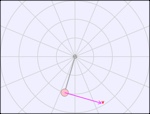
The Mobile Device Accelerometer JavaScript model reads the direction and magnitude of the proper acceleration g. An arrow shows the projection of g onto the screen and output fields show the numerical g components. Users can tilt and shake their device and record the changing acceleration.
Users should lock the screen orientation of your screen to maintain a fixed view.
Users should lock the screen orientation of your screen to maintain a fixed view.
 Block Sliding On An Incline Plane
The Block Sliding On An Incline Plane mobile JavaScript model illustrates the forces and dynamics of a block sliding on a surface. This simulation uses the accelerometer on mobile devices to read the direction of the gravitation field g. A force body (free body) diagram showing the normal force (red), the gravitational force (black), and the force of friction (green) is shown. Users can set the initial position and velocity and can adjust both the static and kinetic coefficient of friction when the simulation is paused.
 Horizontal Mass and Spring Simple Harmonic Oscillator
The Horizontal Mass and Spring Harmonic Oscillator mobile JavaScript model illustrates the forces and dynamics of a simple oscillator. It uses the accelerometer on your mobile device to read the direction of the gravitation field g. A force body (free body) diagram showing the spring force (blue), the normal force (red), the gravitational force (black), and the force of friction (green) is shown. Users can set the initial position and velocity and you can adjust the viscous damping (friction) coefficient when the simulation is paused.
 Vertical Mass and Spring Simulation with Accelerometer
The Vertical Mass and Spring Harmonic Oscillator mobile JavaScript model illustrates the forces and dynamics of a simple oscillator. It uses the accelerometer on your mobile device to read the direction of the gravitation field g. A force body (free body) diagram showing the spring force (blue), the normal force (red), the gravitational force (black), and the force of friction (green) is shown. Users can set the initial position and velocity and you can adjust the viscous damping (friction) coefficient when the simulation is paused.
 Four-Spring Accelerometer Model
The Four-Spring Accelerometer model shows how a mobile device detects acceleration. The simulation displays the forces and dynamics of a small mass connected to four walls by springs. It responds to the direction of the gravitation field g and the mobile device's xy-acceleration.
 Pendulum with Moving Support
The Pendulum with Moving Support model illustrates the forces and dynamics of a pendulum attached to a support. The simulation uses the mobile device accelerometer to read the proper acceleration as measure by the device. This proper acceleration is the acceleration relative to a freely falling observer whereas coordinate acceleration is dependent on the choice of reference frame acceleration. Note that the proper acceleration for an object at rest relative to Earth is +9.8 m/s^2 in the up direction as seen by a freely falling observer.
 Ball on a Moving Ring
The Ball on a Moving Ring model illustrates the forces and dynamics of a ball rolling to a circular track. This simulation uses the accelerometer on your mobile device to read the proper acceleration as measure by the device. The proper acceleration is the acceleration relative to a freely falling observer whereas coordinate acceleration is dependent on the reference frame acceleration and this acceleration (ax, ay, az) is displayed in the simulation. Note that the proper acceleration for a stationary object on Earth is approximately +9.8 m/s^2 because the object is accelerating up as seen by a freely falling observer. The mobile device accelerometer measures proper acceleration because the device is acted on by gravity and by the device acceleration. Subtract the acceleration due to gravity to obtain the coordinate acceleration as defined in introductory physics textbooks. It is interesting to note that proper acceleration is fundamental in Einstein's general theory of relativity because this theory assumes that gravity is equivalent to acceleration in spacetime.